I had been releasing my videos on Thursday each week during Lent, and that meant the last one was released on Maundy Thursday. It focused on the crucifixion, with a little glimpse of hope. This was our artist's reflection.
Tuesday, May 18, 2021
Virtual Lenten Small Group session 6
The theme for this session was "night," using a verse from Psalm 19. Our artist used this as his reflection.
Virtual Lenten Small Group session 5
The word for this session was "slow," with music by Florence Price and and modern art piece by Eric Pause. Our in-house artist created this reflection on all of that.
Virtual Lenten Small Group session 4
The fourth week of our small group used Isaiah 40 as its jumping off point. This was our artists reflection on all the material for that week.
Wednesday, March 3, 2021
Virtual Lenten Small Group session 2
I facilitated a "virtual" Lenten small group this year. "Something music- or art-related," was about all I had to go on. I decided to keep it simple: select a lectionary Bible verse and then curate a piece of classical music and a piece of visual art to go with it. I created a weekly video in which I introduced the Bible verse, music and art piece. With each video I provided links to listen and view the art and music I emailed the link to that to all the participants. Their "participation" in the group consisted of viewing my video and then exploring the music and art piece on their own. I encouraged participants to use the comment section of each of my videos to share their reflections, whether they were on the Bible verse, music or visual piece. Ultimately it seemed to go well. There were some humps getting everyone comfortable with the format, but most everyone managed to get involved eventually.
One of the participants is a visual artist, retired now, but still quite active with his work. Once the small group was announced, along with the format, he said he would offer his reflections on the Bible verses in the form of a piece of his own visual art. I thought this was very cool. I placed his image files in my photostream and put links in the video comments for everyone to click through and view.
Below is his first reflection (week 1/session 1 was an overview with instructions and without links to other art). I'll share his other work in separate posts.
Thursday, January 14, 2021
Neighborhood Nativity
One of the most innovative things we have done during the pandemic is re-imagining our Christmas live nativity. In years past one event or another on a Sunday evening in Advent has concluded with an an outdoor live nativity scene. We cast it this year as a stand-alone event off campus. We adapted our perennial children's Christmas Eve service to provide a script, recording children we might normally use in a live setting. We recorded the same sequence of songs in that service with a solo child singer, in lieu of congregational songs. Instead of a single locale, we created 5 locations among our in-town church families. We recruited those same families, or in a couple of cases some non-family members to portray characters from the nativity story. We created a CD of the narration, songs, and some other brief liturgical elements. We created scenes at the five homes, including costumes and props. Folks picked up a CD from the church facility and then drove around town on a prescribed route to view the scenes while listening to the narration and songs in their cars. We had about 100 cars over the 2-hour course of the event. The response was quite favorable. Below are some shots.
The first stop was "the innkeeper and Mary and Joseph."
Next up was the angels...
Next up were the shepherds in afield. We hired live animals for this stop.
The magi were next. We purchased inflatable camel costumes for this trio of boys and simply told them to have a good time.
The last stop was a complete scene. We asked a large family in our congregation to take this on, figuring they would have the personnel to cast a fairly complete scene. They did! We had planned to let them borrow our scale-model creche scene, but the kids wanted to create their own, including animals, fake and living!
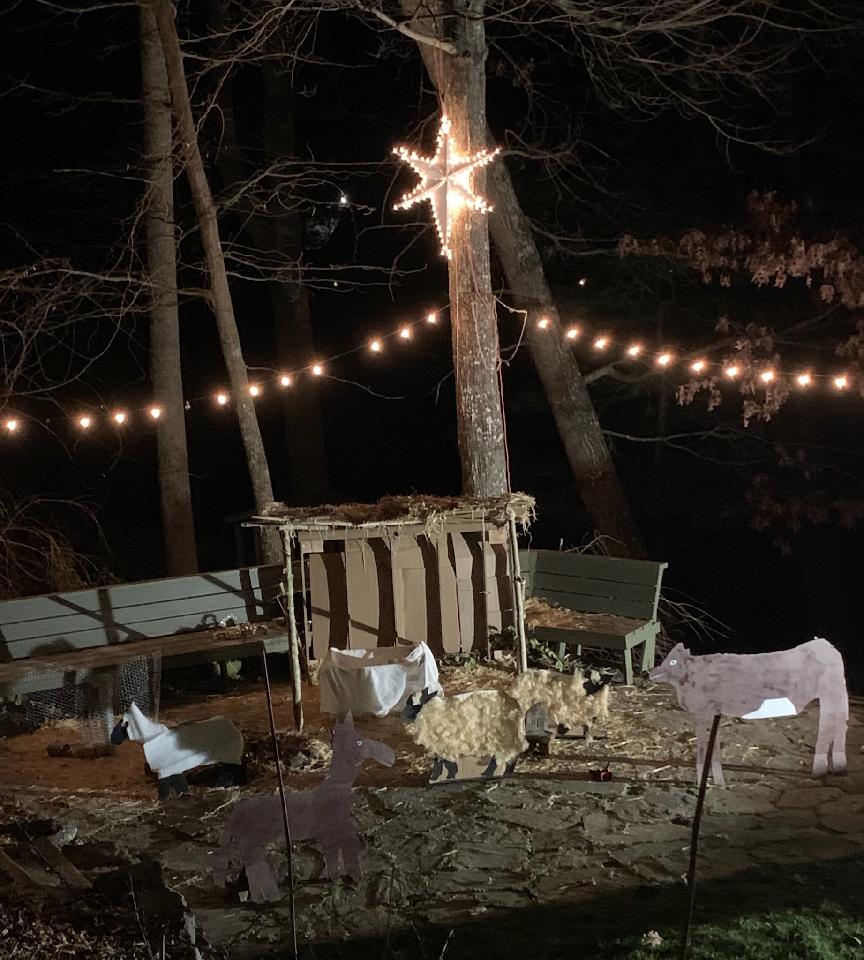
There are years I seek to provide a certain level of authenticity to the live nativity scene, and ask persons to remain in character. Since our congregation had been apart for 9 months at this point, we let those strictures fall, and encouraged everyone to wave and smile and chat with one another from a distance, the better to enjoy the experience. It was a wonderful event. We liked being in the community, and even when we are able to be back together, we may re-cast this yet again and make it bigger and better.
Monday, January 11, 2021
Visuals for Advent 2020
Here is a hodge-podge of images from our visuals during Advent 2020. I made the iron frame back in summer to hold fabric. In Advent it held a wreath and globes that represented candles and/or stars. Early on the frame was bare, but I added black fabric as a base to keep things from showing through between the sides. This first shot shows what the wreath with lights looked like (before the black fabric).
This is the "candle" side. Youth made these globes a couple of years ago for a youth Sunday. I was really delighted I had held onto them. Each one lights. It doesn't quite show but there is a fairy light curtain behind the blue fabric. There is also a glittery toile type fabric in front of the sheer blue piece. The lights glistened through with a pretty cool effect. For Epiphany I changed the blue sheer fabric to gold lame'. It was very dramatic.
Our
big group project was this outdoor Advent wreath. We were slow getting
all four panels finished so their installation was staggered. But the
final effect was good. The hassle was getting the battery-operated
strands turned off and on. The central candle in each panel was on a solar control.
These candles we paired with this large star. A guy into metal-working in our congregation made it. It went up the few days between Advent 4 and Christmas Eve. It's lit from below. About 6 feet across.
I saw a picture from another church that did this and promptly stole it. The green boards are a bit too narrow (I forgot about the fickle nature of lumber measurements). But this was about 3/4 through the season. We took in a huge amount of food for our local ministry partner.
Advent 2019
This is from Advent 2019. I had this on Facebook but never got it here. Our
alternative worship space is set for a dinner at the moment, but this
is the visual installation for Advent-Christmas, a representation of
"immanence" with stars coming near to the earth. This is three hues of toile fabric, with small lights interwoven. A group of youth made the stars several years ago.
Thursday, May 21, 2020
Singing during a pandemic
One of the first things I heard as the pandemic was unfolding several weeks ago, and we began to shelter at home away from friends, family and routines, was, "I miss singing together." Indeed some of the most creative energy I witnessed in response to the pandemic revolved around trying to make music with other people in the midst of isolation. We heard tales of Italians leaning out their balconies to sing in the evenings. We have heard of neighborhoods in the US where persons clap and bang and stomp at sunset as an expression of solidarity, and a testimony against all that is drear.
And then we heard grim reports of choirs that met for rehearsal with one symptomatic person, only for germs to spread on the very breaths of music. We've heard perhaps that singers, as they release music from their bodies, are also potentially "super-spreading" germs.
In the midst of such gloom and despair, and in the midst of such confusion over what is safe and what is harmful, how can we sing the Lord's song? My response, indeed, "how can we keep from singing?" We were designed to give praise to the Creator. We can barely take a breath without vocalizing a hum. It is our creaturely nature to transform vowels and consonants into pitch and rhythm.
Our music-making will look different for a while. But whenever we create music, our pulsing voices join the universal music of the spheres. Singing together in a visible, corporeal way will be suspended for a time. But we know intuitively that corporate music-making continues: mountains sing, trees clap their hands, rivers roar. So I remark every morning that the birds still sing (especially one particularly boisterous robin outside my window); my music making joins theirs. Somewhere around this tremendous globe, someone is singing with me.
Tuesday, June 11, 2019
Pentecost 2019
We went with something of a variation on a theme this year. We've used toile hung from the ceiling in the sanctuary before, but it was more abstract, from point to point.
This year I used a central nexus for the fabric, so the long pieces shot off in various directions. It was hard to get the rack centered and level at height, but the end effect was fine.
We also used toile for the lectern and pulpit paraments, and one of our member's large stained glass made a return appearance.
In the fellowship hall I went with a single strip of toile from ceiling to floor, and then laid more fabrics on top of it to continue under the table all the way to the lectern/podium.
Fabric strips on the table puddled on the floor. The idea was to symbolize the flame engulfing all of the liturgical furniture.
Tuesday, April 30, 2019
Post-Easter installation
Defiant Requiem
In 1868 famed opera composer Giuseppe Verdi was grieving the loss of his colleague, the equally famous Gioachino Rossini. Verdi suggested to his publisher that the leading composers of Italy should collaborate in writing a mass for the dead in Rossini’s memory. Sadly, the project failed and the performance never took place. However, a few years later Verdi realized that the Requiem sections he had written constituted a valuable core that he could develop into a complete work – which is exactly what he did in 1873, and it was performed for the first time in 1874.
Fast-forward to 1941, when Rafael Schächter, a brilliant young conductor, was arrested by the Nazis and sent to the Theresienstadt (TerezÃn in Czech) concentration camp, along with many other accomplished artists and musicians. Schächter was determined to sustain courage and hope for his fellow prisoners by enriching their souls through great music. He recruited 150 prisoners and taught them Verdi’s Requiem by rote in a cellar using a single smuggled score, after grueling days of forced labor. He was forced to reconstitute the choir three times as members were transported to Auschwitz. The Requiem was performed on 16 occasions for fellow prisoners. The last, most infamous performance occurred in June 1944 before high-ranking SS officers from Berlin and the International Red Cross, to support the charade that the prisoners were treated well and flourishing.
Monday, March 18, 2019
Art Installations Lent 2019
The sanctuary:
The fellowship hall:
Folk immediately noticed the missing eagles in the sanctuary. With the blue (water) gone for the second week, things look rather stark already. Some folks have had a bit of a hard time wrapping their heads around "letting go" of certain Bible images, but we hope that repetition of the concept that we are letting go for a time as an act of spiritual discipline will begin to resonate more fully with them.
Thursday, February 21, 2019
Lenten art 2019
Tuesday, February 19, 2019
Good Friday Experience 2016, part 3
I'm not sure what kept me from writing this installment for so long, other than a wish to convey how deeply affecting the whole experience was. I believe I have covered the background and development of the undertaking, so here I will lay out the various stations, with photos.
In the narthex folks could pick up a brochure which would guide them through the rest of the experience. They could also attach pieces of tissue paper to a cross-shaped installation on the window which was made from double-sided clear contact paper. From here the sanctuary was available (quiet and dimly lit, with a sheet of simple prayers and readings) for quiet meditation.
Upstairs we had squares of aluminum foil available to shape into animals. Ideally these would have been animals mentioned in the Bible narrative (donkey, rooster, etc) but we got a variety, and as the evening wore on even non-living sculptures! With one of our resident artists located here, this went much better than one might expect.
In another room persons could use wire and nails to make a cross, of sticks and yarn to make God's eyes. This seemed to appeal to older folks, as I found many of them in this center chatting together all evening!
I asked on of our carpenters to build a wood frame and add nails to serve as a base for weaving yarn as prayers. Over the years our supply of yarn has increased exponentially, and this was a great way to put some of that to use.
I asked one of our other elementary art teachers to create a mural-sized depiction of the Palm Sunday narrative: Jesus, donkey, town, villagers, etc. We provided paints (and smocks) for persons to paint that mural. We also had smaller pieces of paper and markers of various types available for individual, small-scale projects.
Outside we explored the labyrinth as a device for prayer. We had supplies available to make a labyrinth out of paper and sand to take home, and a kid-scaled version to walk in our lawn. It included prayer suggestions along the way. The outdoor aspect helped the children who were participating considerably by providing a place to release some energy.
Finally, we had a simple dinner of soup and bread (and peeps) available in our fellowship hall.
I was delighted with the turn-out, and gratified that folks found meaning in the various stations. I hope we can do something like this again.


